
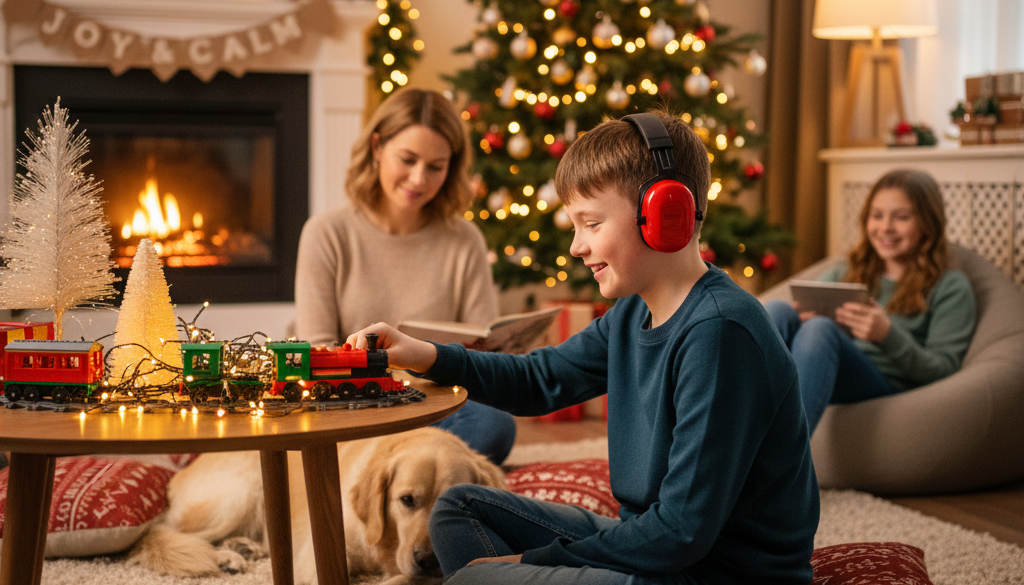
Christmas should be a time of warmth, togetherness and joy for the whole family. For families who have a child with special educational needs and disabilities (SEND), however, the season can bring additional challenges: sensory overload, unpredictable routines, heightened expectations and transitions that don’t quite land. This guide is for you: families who want to create a peaceful Christmas for children with SEND, one that honours your child’s needs, supports siblings, and leaves everyone, including the adults, feeling calm, connected and content.
I’ll cover how to predict and prevent known problems, thoughtful present ideas for children with different types of SEND, best practices when hosting a child with SEND, inclusive activity ideas for mixed-ability groups, strategies for transitions and food planning, and 10 top tips for calming things down. If you’ve seen my article last week “Peaceful family Christmas: joyful ideas that truly work” you’ll find many overlapping themes, but here I’ll focus specifically on SEND support this season.
Predicting and preventing known problems
Many difficulties over Christmas arise not from big surprises but from small, repeated stressors: a sudden change of location, too many visitors, unexpected noise, unfamiliar food, or a break in routine. When supporting a child with SEND, identifying potential triggers ahead of time gives you huge power. The National Autistic Society has some great Christmas tips to help ensure those with autism have a more enjoyable time.
Begin with a pre-season audit: list places, situations or changes you know your child struggles with (for example: communal living room with lots of visitors; bedtime later than usual; bright flashing lights; unexpected food). Once you have the list, you can work on preventive strategies. For instance, if your child dislikes loud carols or TV adverts, build in a quiet room with headphones. If routine changes unsettle them, create a visual schedule of the day(s) ahead and review it together each morning. A laminated or magnetic board works well.
Another crucial step is communication and rehearsal. Talk through any changes weeks ahead: “On Christmas Eve we’ll visit Aunt Sarah’s; afterwards we’ll come home and do our cosy hour.” Role-play or walk through the route if new venues are involved. Familiarity reduces anxiety. Use social stories or simple cartoons.
Finally, plan for escape-routes: identify one place where your child can withdraw if things become overwhelming – a quiet bedroom, headphones with favourite soothing music, a weighted blanket, an ear-defender box. Make sure siblings and adults know this spot is ok and essential. This reduces pressure on your child to “keep going”.
Present ideas for children with a variety of SEND
Choosing gifts that truly support a child’s needs, and bring them genuine joy, makes the season meaningful rather than frantic. Here are suggestions tailored to different profiles, though many will cross categories.
- Sensory regulation gifts: For children who seek or avoid sensory input, consider items like a soft, textured blanket, a calming light-up sensory cube, weighted lap pad, fidget/spinner sets tailored to their age.
- Communication and social skill supports: For children with autism or social communication differences, visual choice boards, emotion cards, simple interactive games that encourage turn-taking, or a hobby set that they can share with a sibling.
- Executive-function supports: For children who struggle with planning, transitions or organisation, consider a colourful visual timer set, an activity-planner board for their room, or a “personal soundtrack” hour with headphones where they can choose calming music when they feel overwhelmed.
- Physical-motor or coordination supports: For children with dyspraxia or motor-delay, adapted gifts such as a stability scooter, large-button music player, or a craft kit with larger grip tools.
- Inclusive family-play gifts: To support siblings and the child with SEND playing together, items like “pass-the-parcel” with non-material prizes, a cooperative board game with simple rules, or a family scavenger hunt with visual clues.
When purchasing, remember: one thoughtful gift + a couple of modest extras often works better than dozens of items. It keeps the focus on meaningful connection rather than quantity.
Hosting a family event when a child has SEND (what to do / not to do)
If you are hosting Christmas – or visiting someone else’s home – with a child who has SEND, some practical steps ensure smoother interactions and reduce stress.
What to do
- Share a pre-visit plan with your guests (or ask for one if you are visiting): expected number of visitors, approximate schedule, quiet zones, meal timing, and exit plan if required.
- Designate a quiet room or corner and make sure adults know it’s fine for the child to retreat there. Label the space if needed so others are aware.
- Keep music, lighting and noise to a manageable level, or provide alternatives (ear-defenders, light-blocking curtains).
- Communicate your child’s cues to siblings and trusted adults: e.g., “When [child’s name] covers their ears it means we’re about to leave.” This helps everyone respond promptly rather than becoming frustrated.
- Offer activities suitable for different ages and abilities in the same room, so children aren’t segregated. Inclusive fun builds connection.
What not to do
- Don’t spring surprise visits or unannounced changes of plan (as much as you can help it!); children with SEND often need forewarning.
- Don’t expect the child to conform with adult-paced events all day; permission to sit out or join later is vital.
- Avoid scatter-shot transitions (e.g., from table to sofa to garden to guests) without warning as these can trigger anxiety or meltdown.
- Resist the idea that you must fill every moment; built-in downtime is essential for everyone’s wellbeing -especially the child with SEND.
Activity ideas for children where there are a mixture of SEND and non-SEND children present
Inclusive activities help blend fun and support, ensuring no one feels “different”. Here are some creative ideas you might not have tried:
- Visual treasure hunt: Use picture clues around the house or garden. Each clue leads to a small prize or coupon (e.g., “pick the film for tonight”, “choose a [Christmas] song to sing”). Children with SEND appreciate the visual cues and clear steps; siblings enjoy the adventure.
- Sensory story time with props: Pick a festive story and equip it with props like a soft scarf/a small bell/a piece of evergreen to cue sensory interaction. Alternating between reading and passing the props keeps all children engaged.
- Co-created décor: Set up a craft corner where children decorate plain baubles with textures, stickers, glitter, and their names. The child with SEND contributes at their own pace and siblings can help or work alongside.
- “Music conductor” game: One child (good idea to rotate) wears a ‘conductor’s baton’ and chooses when to pause or play a favourite upbeat or calming track. This gives children control over sound levels, supports sensory regulation, and encourages siblings to participate.
- Cooking station relay: Simple tasks like decorating biscuits, pouring toppings or mixing ingredients divided into stations. Some children may have motor delays – adapt tasks so everyone can contribute. End with a group taste-test and vote for “funniest decoration” or “most creative”.
These inclusive formats ensure children with SEND are involved, supported and valued and the siblings appreciate the shared fun.
Managing transitions between activities or locations and food ideas to ensure calm
Transitions (moving from one activity to another or changing location) are frequently the flashpoints for children with SEND. Add food, change of environment or visitor buzz, and it becomes a perfect storm of overwhelm. Here’s how to smooth the journey…
Transition strategies
- Use a visual schedule with timers. For example: “After lunch (indicated on a timetable board) we will go for a walk for 10 minutes, then return for present time.” A sand-timer or simple countdown app can help children anticipate.
- Offer a “transition object”. Something the child carries with them during the shift – maybe a favourite soft toy, a pair of sunglasses, or a small notebook. It becomes a soothing link between environments.
- Provide a warning routine. Give a calm two-minute and one-minute warning before the shift: “In two minutes we’re leaving the house.” This prepares the nervous system.
- Keep one consistent adult anchor. Whenever possible, one adult is responsible for the transition. Go together, talk about it, model calm behaviour.
Food planning for ease and calm
Food presents particular challenges: different tastes, textures, smells; buffet chaos; long waits. Some ideas:
- Prepare mini-plates ahead of time: a small portion of preferred foods that the child recognises before they join in a bigger buffet.
- Include safe favourites alongside novelty items. The familiar helps regulate while new things are explored in small steps.
- Use a snack corner where children can self-serve calm snacks (e.g., oat cookies, carrot sticks, a drink) if they want to retreat.
- Time food breaks with transitions: for example, after a walk or craft, everyone eats together…so the change of activity is anchored by food, not separate from it.
- Minimise waiting: if the child finds queuing or watching others eat stressful, serve them first or alongside the adults so they aren’t left observing for long.
YoungMinds has excellent guidance on supporting children with anxiety, which can be particularly helpful during busy festive periods. The ADHD Centre also offers brilliant seasonal advice for managing ADHD overstimulation and routine shifts.
10 top tips for calming things down this Christmas
- Introduce a “quiet cocoon” zone: a corner with soft lighting, calm music and a favourite cushion. Open all day if needed!
- Use a visual “choose your moment” board: everyday the child picks one activity from a board (craft, story, walk) and one moment where they rest.
- Hold a “sound-scape pause”: turn off all Christmas music and TV for 15 minutes each evening; invite everyone to sit, read or draw quietly.
- Create a “traffic-light wardrobe”: for example, green = full festive mode, amber = half mode (e.g., hat but no lights), red = calm outfit for withdrawal time.
- Bake one sensory biscuit batch early: let the child choose textures and smells, freeze extras for less-busy days.
- Run a “role-swap hour”: siblings and child with SEND choose one task each (wrapping, playlist, decoration) to increase ownership and reduce adult burden.
- Set up a “buddy signal”: the child uses a small token (a card or badge) to signal when they need a pause. No words needed.
- Create a “mission-impossible” style walk or game with lights out or low light – turn off overheads, carry torches, and go slowly. It’s fun and soothing!
- Introduce a “gift-of-time” voucher: each person gets a small card representing an hour of one-to-one time—less pressure on presents, more on connection.
- End each day with a “two-star, one-wish” ritual: each person shares two things they enjoyed and one wish for tomorrow. It helps regulate emotions and signals closure.
Final thoughts
Creating a peaceful Christmas for children with SEND is not about lowering expectations. It’s about shifting the focus. From perfection to presence, from overload to enjoyment, from rush to rhythm. Recognise what your child needs, give yourself the tools ahead of time, and build in stops, retreats, choices and quiet.
Wishing you a beautiful season of connection, calm and joy…for your child, for you and for the whole family!


