
When the rain pours and the school holidays stretch ahead, even the most patient parent can feel the pressure. The good news? Wet weather can become a gift. With the right indoor school holiday activities for primary children, your home can transform into a studio, laboratory, theatre, museum and game show stage all in one week!
As a tutor and mum, I’ve seen how purposeful play builds confidence, language skills, resilience and curiosity. Many of these ideas also work beautifully for lower secondary pupils, especially when you increase the challenge or add research, presentation and design elements. My children found many of these ideas better than playing with their toys (“so boring!”).
Below are 25 creative ideas that keep minds active without feeling like “school”. Once you’ve already done welly walks and jumped in puddles, you’ll be ready to give these a go…
Why indoor school holiday activities for primary children matter
Children thrive on structure, even during holidays. Thoughtfully chosen indoor activities benefit in a number of ways:
- Strengthen problem solving and reasoning
- Build language and communication skills
- Support teamwork between siblings
- Develop independence and confidence
- Reduce screen dependence
- Boost mental wellbeing on grey, rainy days
The key is offering choice and ownership. Let your child lead where possible…you may be surprised at what they create!
Creative building and invention challenges
1. Cardboard arcade challenge
Children design and build simple arcade games using cardboard boxes, elastic bands, marbles and tape. Think mini pinball machines, marble mazes, target toss games…older children can add scoring systems, probability discussions or written instructions.
2. One hour invention challenge
Present a household problem: socks always go missing/cereal gets soggy/the pet is bored, etc. They design a solution and pitch it to the adults like Dragons’ Den. This builds persuasive speaking and design consideration.
3. Design a dream bedroom on paper
Children create a scaled floor plan of their ideal bedroom (think maths skills!). Older pupils can calculate area, research real prices and create a realistic budget. Then they can try to persuade you later in the day why they NEED to have this come to life…
4. Design your own country
Children can invent:
- A name
- Flag
- Currency
- Laws
- School system
Older children can draft a constitution, debate political systems or create maps of the new country.
5. Invent a national public holiday
What is it celebrating? What traditions, foods and songs will it include? Will there be any special events to celebrate? Designing symbols and flags adds art and cultural understanding. This one also links nicely to number 4 as an add-on.
Imagination and storytelling adventures
6. Escape room at home
Create a story scenario:
A missing scientist. A trapped dragon. A malfunctioning time machine.
Then create and hide clues in books, envelopes or locked boxes. Include:
- Logic puzzles
- Number codes
- Simple ciphers
- QR codes for tech-savvy families
Older children can design an escape room for younger siblings. Great idea for when children have play dates with friends – older siblings will love to be inventive!
7. Mystery bag storytelling
Place random objects in a bag — a spoon, feather, key, toy car, etc. Children must create a story including every item. This could be written for those who like writing, a film if they have use of a mobile phone/video camera, a storyboard for those who like drawing, and so on.
For older pupils, set a genre like sci-fi, historical, mystery or comedy (be warned – writing comedy is actually quite hard!).
8. Shadow theatre
Use a lamp and paper silhouettes against a wall or sheet. Add sound effects and background music for dramatic flair. This one is extra good when it’s dark outside because of the rain – it makes the lighting that much easier to manage.
9. Human board game
Design a life-sized board game on the floor with paper squares. Children invent rules, challenges and consequences! It becomes a movement-based maths and logic activity, as well as interactive drama (rather than passive play).
10. Create a board game about your family
You just need an A3 piece of paper (or bigger). Add humorous personalised squares:
“You forgot to unload the dishwasher. Go back 2 spaces.” Think of the hilarity this will create! It encourages sequencing and rule creation as well as subtly pointing out activities and chores that may need some practising around the house.
Creative arts and media projects
11. Reverse art challenge
Start with a messy painted sheet of paper. Children must “find” an image by outlining or cutting shapes from it. This strengthens visual reasoning and creative thinking.
12. Stop motion animation
Using Lego, clay or paper cut-outs, children create a short stop motion film. Even 30 seconds teaches:
- Patience
- Sequencing
- Teamwork
- Digital literacy
This one will be great for dipping into and out of over the course of a few days, if need be. Just remember the rule of continuity to make the film believable (i.e. changing clothes/lighting/positioning half way through could be an issue).
13. Mini documentary about the house
Children interview family members about favourite memories in each room. Edit into a short “house history” film.
14. Build a living room obstacle documentary
Turn an indoor obstacle course into an extreme sports event. Add commentary, slow-motion replays, leader boards and athlete interviews. Brilliant for siblings!
15. Become a YouTube scientist
Film simple experiments:
Children should explain the science behind it which will build their confidence and understanding, as well as their film-making skills.
16. Create a newspaper from scratch
Include a variety of different sections:
- Weather
- Sports
- Comics
- Puzzles
- Family interviews
- Fake adverts
This can easily fill a whole afternoon! You just need some A3 paper that you can fold in half and pens/pencils. Simple! It could have a theme for added interest (for children, for sports fans, etc).
Learning through role play and presentation
17. Museum of me
Each child curates a mini exhibition about themselves. They create artefacts, labels, timelines, find photos and deliver a guided tour. This is wonderful for identity, language development and history themes.
18. Mini TED talks
Each child prepares a two-minute talk on something they love — dinosaurs, dance, football or baking. It builds public speaking skills and confidence. Wonderful to film for prosperity!
19. Write and perform a family quiz show
One child becomes host. Include questions about:
- General knowledge
- Silly challenges
- Drawing rounds
- Music (humming only!)
Children can work with siblings to create questions and can ask these of the adults later in the day.
20. Indoor camping night
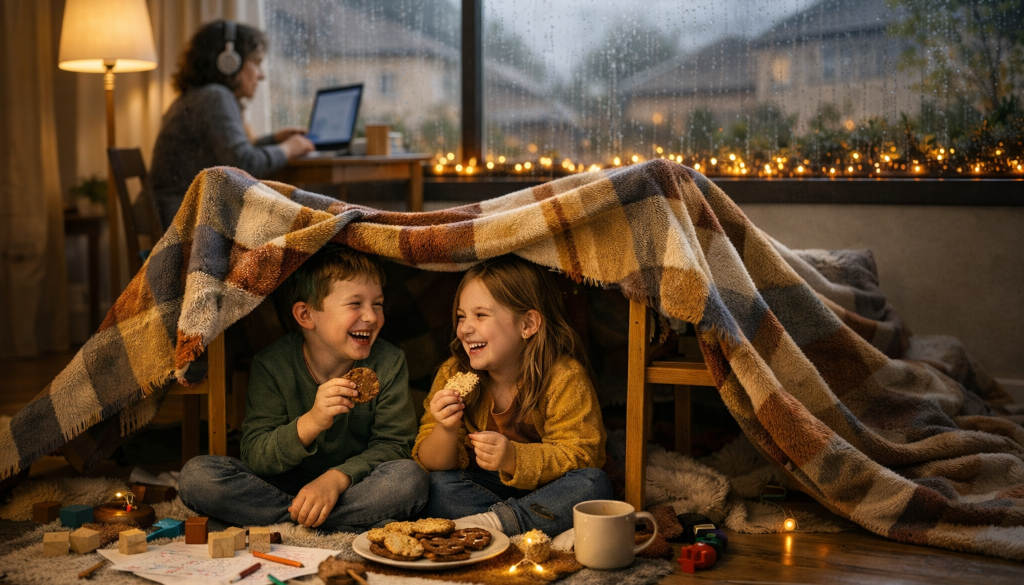
Build a blanket den. Use torches. Tell stories. Make supervised “campfire” snacks like s’mores (one chocolate biscuit – chocolate side up – with a marshmallow on top, microwave for 30 seconds and then remove and put a second chocolate biscuit on top to ‘squish’ the marshmallow in the middle). It creates magical memories even in the rain. Remember to take photos…
Problem solving and investigation fun
21. Indoor treasure hunt with riddles
Instead of simple clues, use:
- Rhyming riddles
- Mirror writing
- Number codes
- Simple ciphers
Perfect for stretching reasoning skills.
22. Indoor treasure archaeology
Hide “artefacts” in rice, sand or shredded paper in a shallow tray or large oven dish. Children excavate using brushes and document findings like archaeologists using photos and ‘reports’.
23. Cook from three random ingredients
Choose three cupboard ingredients. Children invent a snack or dessert. Older pupils design recipe cards and score presentation and can help supervise their production, if appropriate!
24. Make a time capsule
Children choose objects representing today’s world and write letters to their future selves. Hide it somewhere safe. Include photos, today’s date (or newspaper front page), what is number one in the music charts, what their favourite subject at school is, who is prime minister, etc.
25. 24-hour kindness challenge
They secretly complete kind missions throughout the day. At the end, reveal everything to the family. It shifts the whole mood indoors and strengthens empathy. And you will probably see many more smiles than usual!
Making indoor school holiday activities for primary children manageable
You do not need to do all 25. Choose one per day. Or allow your child to pick three options and plan the week together.
If your child has SEND, consider:
- Breaking tasks into small steps
- Using visual checklists
- Allowing movement breaks
- Offering sensory-friendly materials and keeping noise to a minimum
Purposeful indoor play can reduce anxiety, build skills and restore calm during long wet holidays, especially when they are planned together with the child – with no surprises if they struggle with those. If you need some quiet time to work, many of these ideas (once set up by an adult) will buy you precious time to get things done.
And remember — it doesn’t have to be perfect! You can mix and match some activities and stop/start as you please (and as the weather dictates! When the weather improves, you might want to check out other ideas for fun educational activities in the holidays that will get you out a bit more).
What matters most, above all, is connection, curiosity and shared laughter because that’s what will build memories of your time together during the holidays.


